TRUST ENFORCED AS CONTINUOUSLY AS THREATS EMERGE

Trust Must Be Earned Every Moment

Most security breaches begin with access gained through credential compromise.


Every helpdesk ticket starts with access that should have been automated.


SecureW2 solves both issues by making access rights as dynamic and automated as the threats you face.


It's time to make trust work as hard as you do.

Authenticated ≠ Trusted Forever

Authentication is a Snapshot. 
Trust is Dynamic.

The biggest security blind spot? Believing that "authenticated" means "trustworthy." Authentication represents a fixed moment in time, yet threats happen continuously.

Here's one way this gap gets exploited:

8am

User logs in from a managed laptop using SSO. Device health is compliant. MFA passed. Certificate valid.

SIEM logs show everything green. Identity and device appear trustworthy.


Trust level: High

12pm

User clicks a phishing link. Attacker captures session token and credentials.

They pivot to a VM that passed compliance checks earlier but is now idle and unmonitored. No re-authentication is triggered. Security tools still show full trust.


Trust level: Still High

4pm

Attacker moves laterally, escalates privileges, and accesses sensitive systems.

The system still shows the identity as verified and the device as compliant. By the time exfiltration is detected, the attacker had 4 hours of uninterrupted access.


Trust level: Unchanged. Compromise complete

Static trust created a 4-hour window of undetected access.

Authenticated ≠ Trusted Forever. This is the gap attackers exploit.

4 Hours
Undetected breach window

3 Stages

Login → Compromise → Exfiltration

ACCESS IS STILL THE POINT OF FAILURE

The Breach Reality Check

24 days

Median dwell time before detection.

Attackers linger long after login.

42%

Breaches began with stolen credentials, phishing, or edge device exploitation.

Static trust gives attackers their way in.

44%

Breaches involved ransomware, up from 32% last year.

Credential misuse drives escalation and impact.

Statistics from 2025 Verizon DBIR

Most breaches don't start at login. They spread after.

Attackers move laterally and exploit trusted sessions long after credentials are accepted.

Static trust creates windows of exposure that are wide open to exploitation.

The problem isn't just passwords or static credentials.

It's the assumption that trust, once granted, remains valid even as identity, device posture, or risk conditions change. SecureW2 JoinNow addresses this attack surface vulnerability.

NOT ALL CERTIFICATES ARE CREATED EQUALLY

Passwords Aren't the Only Problem

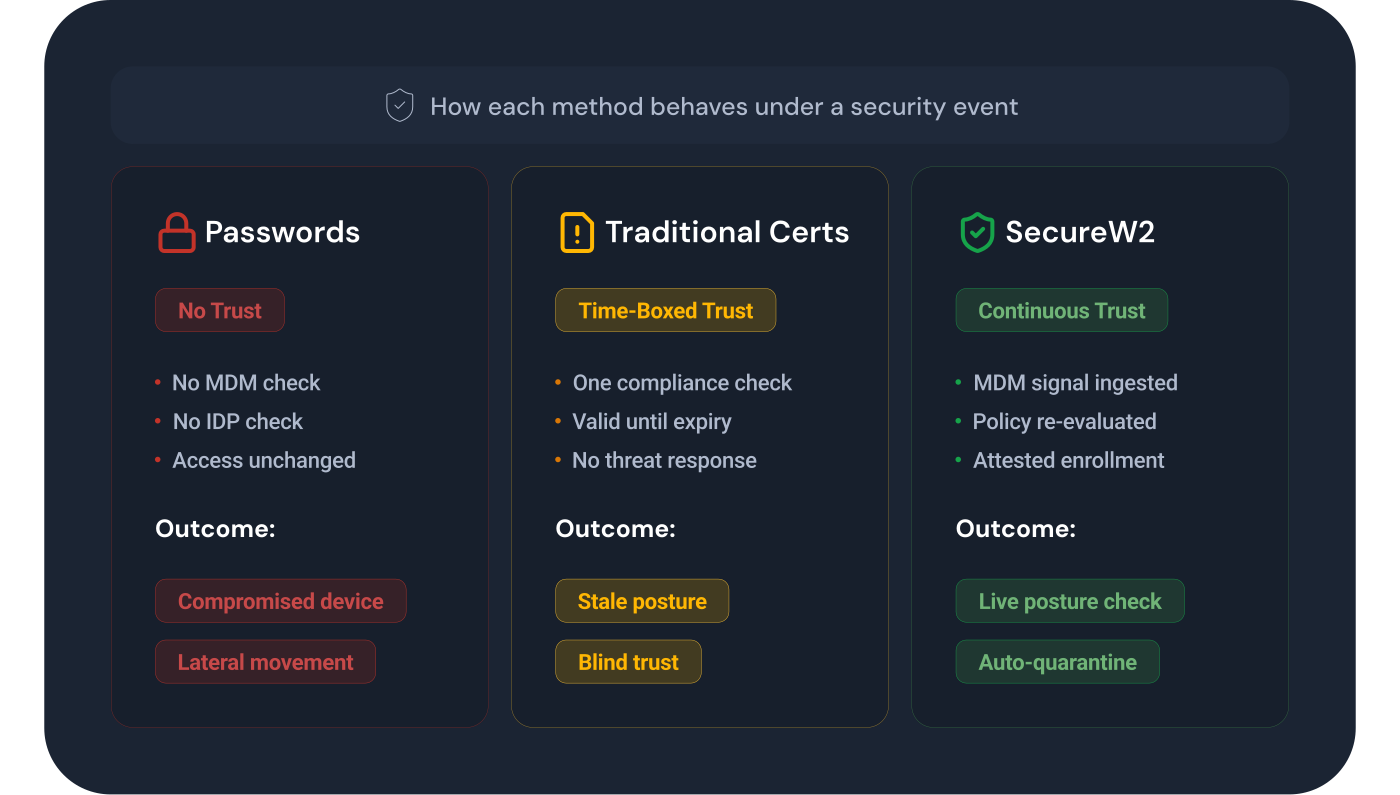
Yes, passwords, PSKs and shared secrets are weak. But replacing them with certificates that don't adapt to changing conditions?

That's just a slower failure.

Every authentication solution falls somewhere on this spectrum. Traditional certificate approaches simply move the vulnerability from "password never changes" to "trust never expires."


Real security requires continuous trust monitoring and enforcement. A lapse in either = exposure to breach.

"

This isn't only about authentication.
It's about a new trust enforcement paradigm.

"

CONTINUOUS TRUST ENFORCEMENT

SecureW2's Defense-in-Depth Model
for Certificate-Driven Security

We've redefined certificates as living trust objects that dynamically adapt in real time. Our cloud-native Dynamic PKI and Cloud RADIUS enforces security across the entire trust lifecycle, from issuance to live enforcement to post-issuance anomaly detection.

01

LAYER 01

Pre-Issuance Validation

SecureW2 improves access control by verifying identity, posture, and risk in real time before any certificate is issued. Dynamic SCEP and ACME Device Attestation produce hardware-bound, fully attested certificates that give you stronger assurance at every point of access.

Real-Time AssessmentACME Device AttestationDynamic SCEP

02

LAYER 02

Adaptive Defense

Once issued, certificates remain adaptive and context-aware. SecureW2 continuously collects telemetry across identity, device, and risk vendors. Policies respond instantly to any change in conditions, with Adaptive Defense updating certificate trust status in real time so there's never a security lapse.

Policy-Based ControlsQuarantine & RemediateCondition-Aware

03

LAYER 03

Advanced Anomaly Detection

SecureW2 applies ML-driven anomaly detection to uncover certificate misuse and prepares your environment for quantum-safe crypto agility, tightening control against present and emerging threats.

Spoofing PreventionCryptographic AgilityPost-Quantum Readiness

01

Pre-Issuance Validation

02

Adaptive Defense

03

Anomaly Detection

Three Layers.
One Unified Platform.

SecureW2's defense-in-depth approach seamlessly integrates Pre-Issuance Validation, Adaptive Defense, and Anomaly Detection into a single, contextually-aware platform.

The secret that unifies these three layers?

Contextual intelligence that gives you a 360-degree view of all devices and their profiles at all times.

Trusted by 1,000+ organizations worldwide
THE VISIBILITY YOU WANT & THE CONTROL YOU DESERVE

360-Degree View of Your Device Ecosystem For Complete Access Control

Traditional credentials and network access control solutions provide minimal security context. SecureW2's adaptive certificates deliver comprehensive device and user intelligence for every access decision.

SecureW2 Adaptive Certificates VS Static Credentials
Category SecureW2 Adaptive Certificates Static Credentials
User Context
User Attributes User Groups User Email Conditional Access
Basic Username Only
Device Intelligence
Device Serial Number Device Build Model Operating System Model Number MAC Address Corporate Issued or Personal
No Device Identification
Cryptographic Security
Issuing Certificate Authority Certificate Validity Period
Password-based Only, Static Expiration
User Context
SecureW2 Adaptive Certificates
User Attributes User Groups User Email Conditional Access
Static Credentials
Basic Username Only
Device Intelligence
SecureW2 Adaptive Certificates
Device Serial Number Device Build Model Operating System Model Number MAC Address Corporate Issued or Personal
Static Credentials
No Device Identification
Cryptographic Security
SecureW2 Adaptive Certificates
Issuing Certificate Authority Certificate Validity Period
Static Credentials
Password-based Only, Static Expiration

Rich Context Enables Custom Policies For Complete Access Control

With SecureW2's adaptive x.509 certificates, every decision is informed by comprehensive, real-time device and user context.
This enables granular, risk-based policies that traditional credentials simply cannot support.

From Certificate Context to Complete Control

With rich contextual intelligence in place, SecureW2 enables comprehensive access control across your entire infrastructure.

Complete Access Control Architecture

SecureW2 enables the full spectrum of access control models with adaptive, context-aware enforcement that traditional network access control solutions cannot match.

Access Control Model SecureW2 Enables
Role-Based Access Control (RBAC)

Assigns users to roles with permissions that adapt based on real-time trust conditions

Dynamic role assignment through SecureW2's certificate-based identity

Attribute-Based Access Control (ABAC)

Makes granular access decisions using multiple attributes with continuous validation

Continuous device and user context feeds SecureW2's attribute decisions

Policy-Based Access Control (PBAC)

Enforces organizational policies with adaptive controls that respond to changing risk

Organizational policies enforced automatically via SecureW2's engine

Risk-Based Access Control

Dynamically adjusts permissions based on real-time risk assessment and device health

Real-time trust scoring enables SecureW2's risk-based decisions

Rule-Based Access Control (RuBAC)

Applies predefined rules with continuous validation of conditions and context

Predefined conditions validated continuously by SecureW2's rules

Zero Trust Network Access (ZTNA)

Implements "never trust, always verify" with hardware-bound certificate validation

Hardware-bound certificates deliver SecureW2's zero trust verification

Discretionary Access Control (DAC)

Enables resource owners to control permissions with automated trust enforcement

User-controlled permissions secured through SecureW2's trust framework

Mandatory Access Control (MAC)

Enforces security classifications with continuous validation and adaptive controls

Security classifications enforced by SecureW2's adaptive controls

Role-Based Access Control (RBAC)

Assigns users to roles with permissions that adapt based on real-time trust conditions

Dynamic role assignment through SecureW2's certificate-based identity

Attribute-Based Access Control (ABAC)

Makes granular access decisions using multiple attributes with continuous validation

Continuous device and user context feeds SecureW2's attribute decisions

Policy-Based Access Control (PBAC)

Enforces organizational policies with adaptive controls that respond to changing risk

Organizational policies enforced automatically via SecureW2's engine

Risk-Based Access Control

Dynamically adjusts permissions based on real-time risk assessment and device health

Real-time trust scoring enables SecureW2's risk-based decisions

Rule-Based Access Control (RuBAC)

Applies predefined rules with continuous validation of conditions and context

Predefined conditions validated continuously by SecureW2's rules

Zero Trust Network Access (ZTNA)

Implements "never trust, always verify" with hardware-bound certificate validation

Hardware-bound certificates deliver SecureW2's zero trust verification

Discretionary Access Control (DAC)

Enables resource owners to control permissions with automated trust enforcement

User-controlled permissions secured through SecureW2's trust framework

Mandatory Access Control (MAC)

Enforces security classifications with continuous validation and adaptive controls

Security classifications enforced by SecureW2's adaptive controls

Comprehensive Coverage

Unlike traditional solutions that only support one or two access control models, SecureW2's Continuous Trust Framework enables all major access control architectures with dynamic, context-aware enforcement.

REAL-WORLD APPLICATIONS

Certificates Issued by Policies Tailored to Your Environment

Our layered defense approach covers your network infrastructure and workloads continuously 24/7/365. Explore how SecureW2's adaptive certificates may be used to segment access and enforce trust.

/ NETWORK AUTH
/ SSO & WEB APPS
/ ZTNA/VPN
/ DESKTOP LOGIN
/ GUEST WI-FI
/ NON-HUMAN IDENTITIES
SecureW2 / NETWORK AUTH

Modernize Auth for Wired and Wireless Networks

Fast, reliable 802.1X and Cloud RADIUS authentication for Wi-Fi and wired access—powered by real-time policy evaluation and passwordless certificate-based access that adapts to identity, posture and risk.

INTEGRATIONS

SecureW2 / SSO & WEB APPS

Device Trust for SSO and Applications

Dynamically issue x.509 certificates through policies that authorize scoped access based on role, risk and device context. Enforce least-privilege access to SaaS and internal apps from trusted devices only.

INTEGRATIONS

SecureW2 / ZTNA/VPN

Enforce Least-Privilege Access for Remote Workers

Enable secure distributed access with certificate-based ZTNA and VPN integrations. Dynamic policy decisions authorize access based on real-time signals from your existing security stack.

INTEGRATIONS

SecureW2 / DESKTOP LOGIN

Passwordless Desktop Authentication

Enforce certificate-backed login with YubiKeys, smart cards and other hardware tokens. Dynamic certificate management supports PIN and PUK functionality and automates enrollment, renewal and slot assignment.

INTEGRATIONS

SecureW2 / GUEST WI-FI

Deliver Guest Wi-Fi with Role Limits and Expiration

Provision guest access with minute-level control. Supported methods include sponsor approval and self-registration through Captive Portal, plus directory integration with LDAP, Google, PowerSchool and SAML.

INTEGRATIONS

SecureW2 / NON-HUMAN IDENTITIES

Scoped Access for Autonomous Workloads

Issue certificates specifically provisioned for pipelines, containers, scripts and AI agents. Scope access dynamically with ACME and policy tuned for systems that operate on their own. No shared keys or secrets.

INTEGRATIONS

TRUSTED BY THE WORLD's BEST

Join 1,000+ global organizations who rely on SecureW2 for continuous trust enforcement

Gallery Image
Gallery Image
Gallery Image
Gallery Image
Gallery Image
Gallery Image
Gallery Image

Best support and implementation experience in my career.

Josh H., Senior Security Engineer
FREQUENTLY ASKED QUESTIONS

Understanding
Continuous Trust

Common questions about our approach to dynamic security and real-time trust evaluation

What is Continuous Trust vs Zero Trust?

Zero Trust establishes the principle of 'never trust, always verify' but often relies on static verification at login. Continuous Trust takes this further by continuously validating trust status in real-time throughout the entire session, adapting instantly to changing conditions like device posture, location, or threat intelligence.

How does dynamic trust differ from static authentication?

Static authentication verifies identity once at login and maintains that trust until logout. Dynamic trust continuously evaluates trust signals - device health, user behavior, network location, and threat context - adjusting access permissions instantly as conditions change.

What makes certificates better than passwords for continuous trust?

Certificates are cryptographically bound to devices and can carry rich metadata about device posture, compliance status, and trust signals. Unlike passwords, certificates can be automatically renewed, revoked, or updated based on real-time conditions, enabling true continuous trust evaluation.

How quickly can trust status change with SecureW2?

Trust status changes happen in real-time - within seconds of a condition change. When our platform detects a device compromise, policy violation, or risk signal change, access permissions are instantly updated across all connected systems and applications.

What happens during a security breach with continuous trust?

Continuous trust dramatically reduces breach impact by instantly revoking access when threats are detected. Instead of 32-day average dwell times, compromised devices lose access immediately, containing lateral movement and preventing data exfiltration.

How does SecureW2 integrate with existing security tools?

SecureW2 integrates with over 100+ security tools including SIEM, EDR, identity providers, and network infrastructure. Our platform consumes threat intelligence and device posture data from your existing tools to make real-time trust decisions.

Have more questions about continuous trust?

READY TO TRANSFORM YOUR SECURITY

Your Dynamic Security Journey
Starts Here

Whether you're just migrating to the cloud and adopting passwordless authentication, or you're architecting the highest assurance security for your network and workloads, we meet you where you are and guide your transformation toward dynamic, continuous trust.