Key Takeaways
- SCEP automates certificate management for managed device in an MDM. With an API key and a shared secret, users can self-enroll themselves for a certificate without the need for manual intervention.
- Static SCEP API key can be intercepted by a hacker. Once a hacker gets the API key, they can manipulate the CA request for a malicious certificate.
- Dynamic SCEP produces a different challenge API key everytime a request is made, thus preventing MITM attacks for added security
Simple Certificate Enrollment Protocol (SCEP) streamlines secure certificate issuance across networked devices, enabling scalable authentication and encryption. Instead of relying on manual provisioning, SCEP automates the process, allowing devices to request certificates directly from the Certificate Authority (CA) through a secure protocol. Devices without valid certificates are denied network access, ensuring only trusted devices can connect.
Microsoft Intune and Jamf leverage SCEP to manage certificates for devices, routers, switches, and applications, delivering a secure and seamless network experience. By deploying SCEP, organizations can eliminate the risks of misconfigured certificates and automate certificate management, reducing operational overhead and strengthening network security. It’s a proven way to enforce secure connections while saving time and resources.
What Is Dynamic SCEP?
A dynamic SCEP is a challenge password generated dynamically and assigned to a device by an MDM, like Intune or Jamf.
The dynamic SCEP challenge password is signed and encrypted by the MDM. When a device sends a certificate enrollment request, the SCEP server sends the CSR and the encrypted password to the MDM for validation. Upon successful verification, the device can enroll certificates for network access.
See your security gap before attackers do.
See continuous trust in action on a platform that includes RADIUS, PKI and AI security.
A dynamic SCEP key consists of the following:
- A dynamically generated password that changes every time a new request is placed.
- Parameters that are expected in the CSR.
- The expiry time of the challenge password.
Traditional Simple Certificate Enrollment Protocol (SCEP) streamlines secure certificate issuance across networked devices, enabling scalable authentication and encryption. Instead of relying on manual provisioning, SCEP automates the process, allowing devices to request certificates directly from the Certificate Authority (CA) through a secure protocol. Devices without valid certificates are denied network access, ensuring only trusted devices can connect.
But relying on traditional SCEP has its risks: static challenge secrets and requiring only a pre-shared key can lead to security vulnerabilities. And that’s where the dynamic sister-protocol steps in.
Dynamic SCEP vs SCEP
A dynamic SCEP challenge enhances security by producing a different SCEP challenge key instead of a static one every time. This prevents the misuse of passwords and ensures that only trusted devices and authorized users can authenticate themselves to a network.
| Features | SCEP | Dynamic SCEP |
|---|---|---|
| Password | It uses a static challenge secret for all devices. | It uses a dynamic challenge password generated by the MDM |
| Challenge Type | Static SCEP requires only a pre-shared key for any authentication needs. | Dynamic requires a service account to authenticate a challenge password. |
| Security | It is less secure as it heightens the chance of unauthorized access | It is more secure as it does not authorize devices with the wrong password to access the server. |
| Configuration | SCEP challenge password provides the pre-shared key upon enrollment. | Dynamic SCEP requires to be configured in an MDM. |
Do SCEP Deployments Leave Your Network Unsafe?
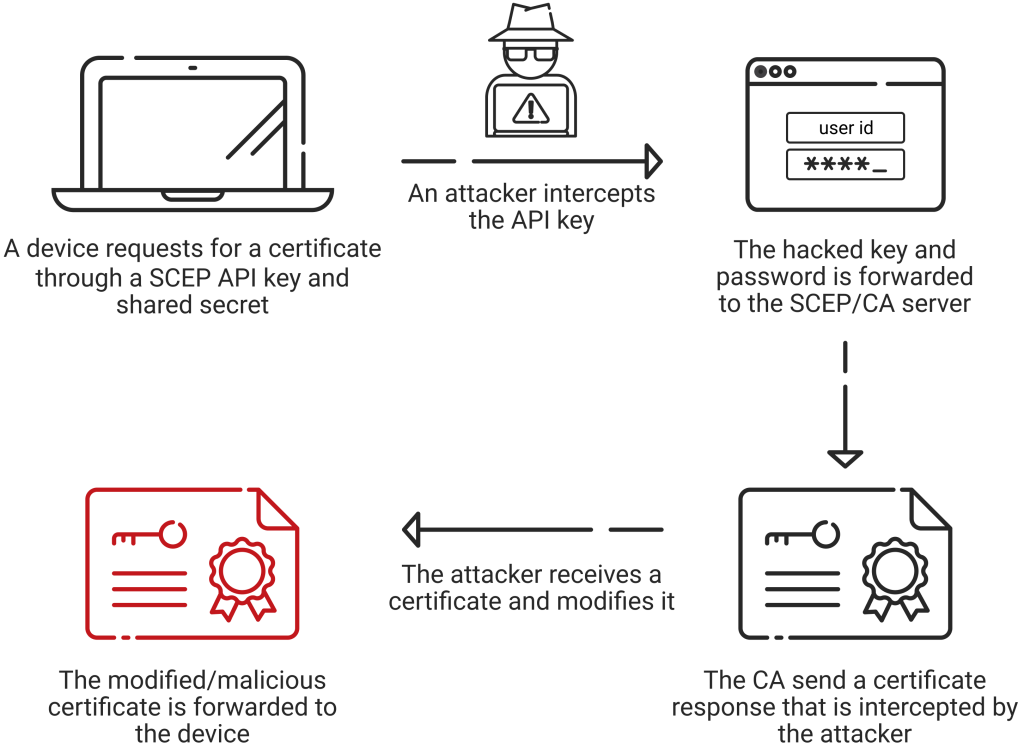
SCEP automates the distribution of certificates to end users in an organizational network, but it does not authenticate or identify the user. If a user has an SCEP challenge password, they can submit a request for a certificate using the same password generated for the organization.
This SCEP model, with a single URL, would work effectively in an admin-only mode. However, SCEP challenge passwords become a concern when used by end users and devices outside the trusted network, such as with MDMs and BYOD scenarios.
This would allow the user or device to take the SCEP challenge password and get a certificate for a different user level with higher network access or a different CA certificate than the intended one. It would also allow an attacker to pose as a legitimate user and use the challenge password to orchestrate attacks on the network.
Dynamic SCEP Best Practices For A Network Environment
Reusing the same challenge password can make the network vulnerable to unauthorized access by attackers and users. Organizations should follow these best practices when using SCEP:
- Use a separate Intermediate CA for each user group, which provides more security. Intermediate CA’s are hosted from separate locations and help protect the primary CA’s key. If there is a possible attack, it would be contained with an intermediate group rather than affecting the root CA.
- Implement an effective Software Information and Event Management software (SIEM) tool across the organization to collate and manage digital assets. A SIEM tool recreates past events and looks at newer incidents to better monitor malicious and suspicious activities.
- Use ACME instead of SCEP for Apple devices on Jamf, as it provides more secure certificate issuance by using HTTPS to place a CSR.
- Use a Dynamic SCEP Challenge password to configure a dynamic challenge in the profile for a more secure URL instead of a pre-shared key.
See your security gap before attackers do.
See continuous trust in action on a platform that includes RADIUS, PKI and AI security.
Dynamic SCEP With SecureW2 For A More Secure Network
An organization must have a scalable and usable certificate distribution system to successfully deploy certificate-based authentication in a network environment. SecureW2’s Managed Gateway API uses dynamic SCEP to deploy certificate-based authentication with EAP-TLS in a WPA2-Enterprise network environment for secure, passwordless authentication.
SecureW2 works with an Intune CA partner to create an Identity Provider (IDP) in our JoinNow management portal to help communicate with Intune. An identity provider supplies the endpoint URL to be added to the SCEP profile in Intune. The Certificate Authority (CA) is used here to configure the SCEP process.
Jamf is SecureW2’s preferred Technology Partner, and they have excellent SCEP support and are widely used across the industry. SecureW2 also provides auto revocation of certificates through dynamic SCEP on Intune and JAMF, thus minimizing the admin’s effort to revoke expired certificates manually.
Get a quote to build your scalable certificate-based network.
